Kolam Mask called "Naga Rassa" (නාග රාස්ස)
2022 April 02
By Janaka Samarakoon
The 'Nâga Rassa' mask is used in Kolam, a traditional folk theatre form often described as a “rural opera,” performed in the coastal towns of southern Sri Lanka. The Sinhalese word kolam refers to a “masquerade,” “fantastic apparition,” or “aberration,” highlighting the surreal and allegorical nature of the performance and its masks.
Rooted in a myth dating back to the legendary royal couple Mahasammata and his queen, the Kolam narrative unfolds through a series of loosely connected episodes combining dialogue, verse, dance, and mime. Traditionally staged to heal a pregnant woman from her supposed harmful cravings—following the example of Queen Mahasammata as preserved in popular belief—this theatrical ritual carries a moral undertone. Its stories, often drawn from the life of the Buddha or from satirical tales about the human condition, serve both a didactic and a cathartic function.
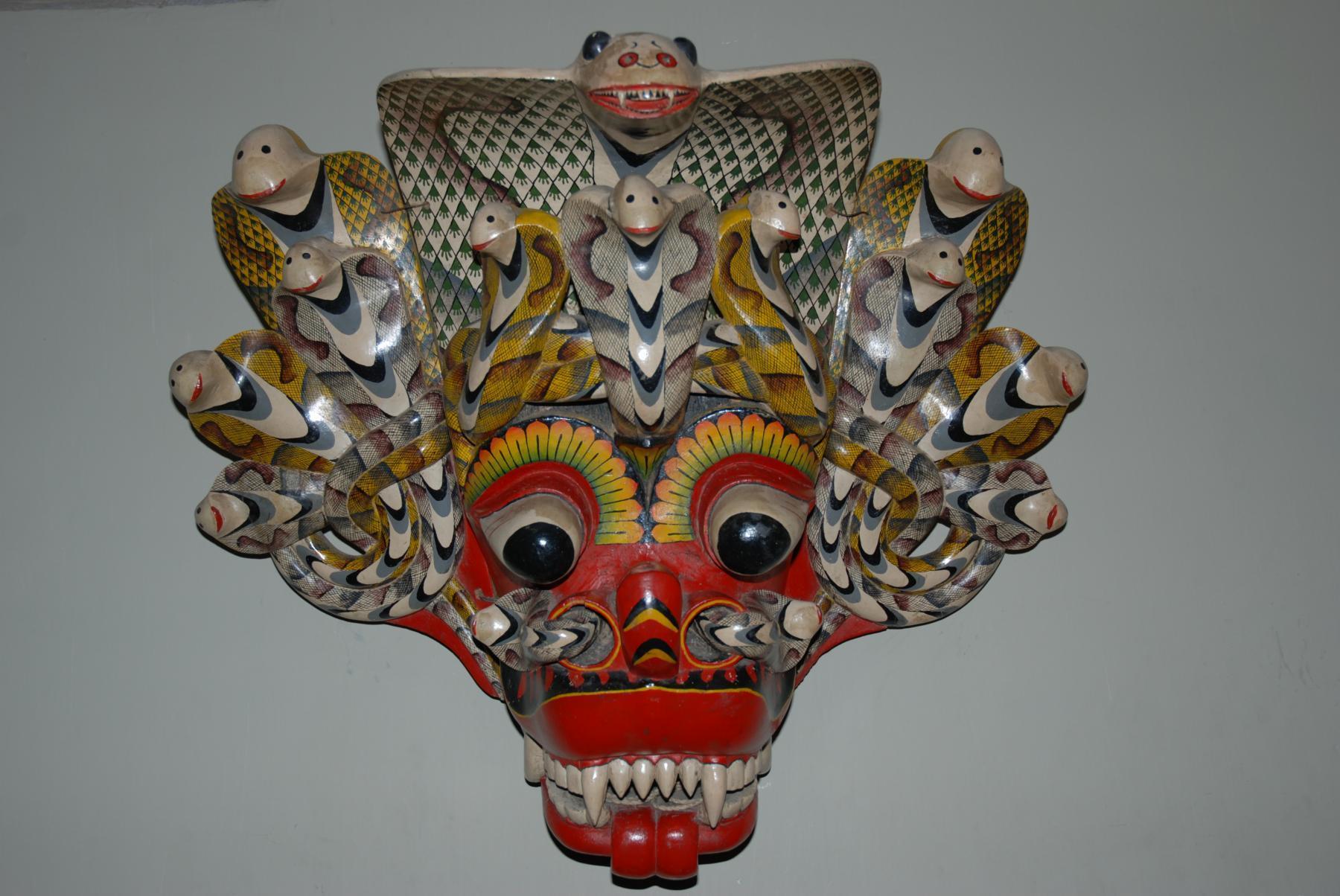
The Nâga Rassa mask, a polychrome wooden artifact preserved in the Mask Museum of Ambalangoda [1]—considered the epicenter of Sri Lanka’s mask-making tradition—is attributed to the most celebrated figure of the legendary Ariyapala artisan lineage: Ariyapala Gurunnanse (“master”).
This particular mask represents the “cobra demon,” whose head is encircled by a fan-like arrangement of serpents in two superimposed registers. These form three distinct zones that emphasize the architectural structure of the head and define the demon’s forehead and ears. Painted in muted shades of grey, ochre, yellow, and green—evocative of natural snake coloration—these elements contrast strikingly with the vivid red of the face. Through the interplay of alternating tones and bold contrasts, the artisan accentuates the mask’s tripartite composition while creating a dynamic impression of writhing, multiplying serpents.
The demon’s bulging eyes protrude from their sockets; two cobras emerge dramatically from its nostrils; and its gaping mouth reveals oversized fangs—a hallmark of all Sri Lankan demon masks.

Image courtesy © OAK - RAY REGENCY
The appearance of Nâga Rassa on stage occurs during the Rassa Kolama, a sequence that features a pantheon of twenty-four demons. At this point in the performance, the mask introduces a visceral element of horror to the dramatic representation. Its role is to terrify the audience—and symbolically, the mythical Queen Mahasammata—into expelling the unhealthy desires believed to have taken hold of her body. These desires are personified as malevolent spirits, and their exorcism through fear becomes a central function of this scene.
Though the stage is said to tremble at the sight of Nâga Rassa, its dominion is short-lived. The mask’s dramatic reign ends with the arrival of Gurula [2], the majestic king of birds and eternal nemesis of serpents. In both the performance and the legend, Gurula vanquishes the snake demon, driving it offstage and reestablishing harmony—just as, according to myth, it once rid ancient Lanka of venomous serpents, rendering the island habitable for humankind.
Intended to both mesmerize and terrify, the Nâga Rassa mask has long fascinated observers. It was already known in Europe by the early 19th century, thanks to accounts by British colonial writers. One such mask was prominently displayed at the Ceylon Pavilion during the 1900 Exposition Universelle in Paris. Nâga Rassa exemplifies the richness and complexity of Sinhalese mythology, in which ancestral fears preserved through collective memory are intricately woven with religious symbolism and legendary narratives.
Janaka Samarakoon - Paris, August 8, 2008
—
[1] This private museum, which opened its doors in 1987, was founded by the Ariyapala & Sons company.
[2] Gurula is also known as Garuda, the vehicle of Vishnu, the son of Kashyapa and Vinatâ, and the brother of Aruna, the driver of Sûrya's chariot.
Originally published in "Sur les traces du serpent... L'aventure d'une exposition" (On the Trail of the Serpent... The Adventure of an Exhibition), a book edited in 2008 by ENS LSH Lyon under the direction of Marie Gautheron and Claire Merleau-Ponty
Share this article