
The Kandyan Period Frescoes – A Window into Sri Lanka’s Sacred Art
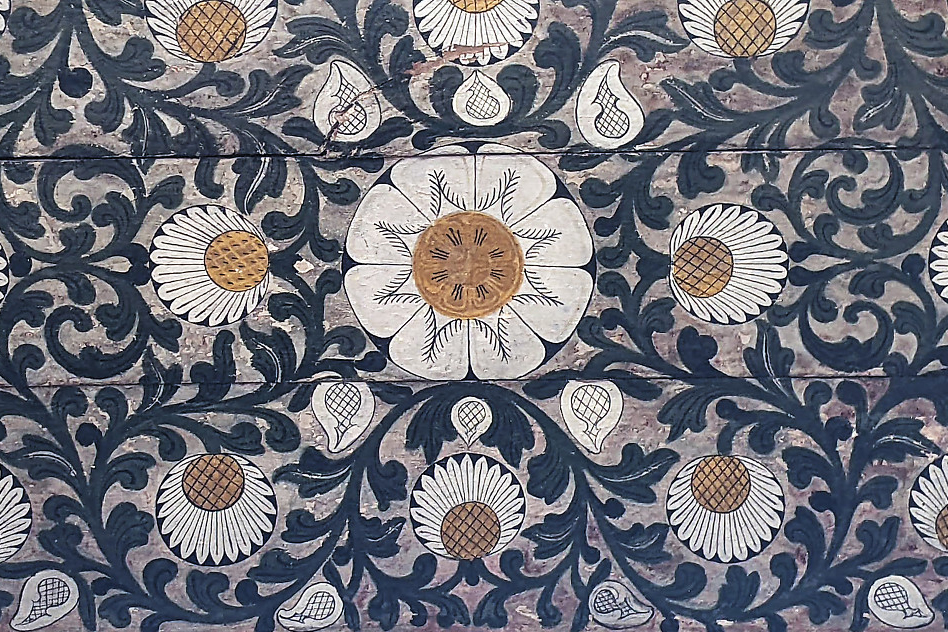
The “kandyan school” of painting flourished under the last kings of sri lanka, centred in the hill capital of kandy.
While the Kandyan period formally spans from 1469 to 1815 — ending with the British conquest — its distinctive pictorial style reached full maturity in the mid-18th century, during the reign of King Kirti Sri Rajasinha (1747–1782).
Historical Background
At that time, Kandy was more than a political capital — it was a sacred city. The presence of the Buddha’s Tooth Relic, brought here by King Vimaladharmasuriya I in the late 16th century, conferred spiritual legitimacy on the monarch and made the city the island’s foremost centre of Buddhist devotion.
By the early 1700s, however, Buddhism in Sri Lanka had suffered deep decline. Catholic missionary work, political instability, and the rise of opportunistic community of “ganinnanse” pseudo-monks had eroded the monastic order. In 1753, King Kirti Sri Rajasinha, working with the learned monk Weliwita Sri Saranankara, restored the higher ordination of monks by inviting senior clergy from Siam — a turning point that sparked a Buddhist renaissance.
This revival extended to the arts. Temples were built or renovated across the kingdom, creating unprecedented demand for mural painting. The Temple of the Tooth became a laboratory for artists, pushing the boundaries of design and narrative. Workshops led by masters like Devaragampola Silvatenne Unnanse and Deldeniya Sittaranaide developed a distinctive “Kandyan” idiom that quickly spread beyond the central region to the coasts and south.
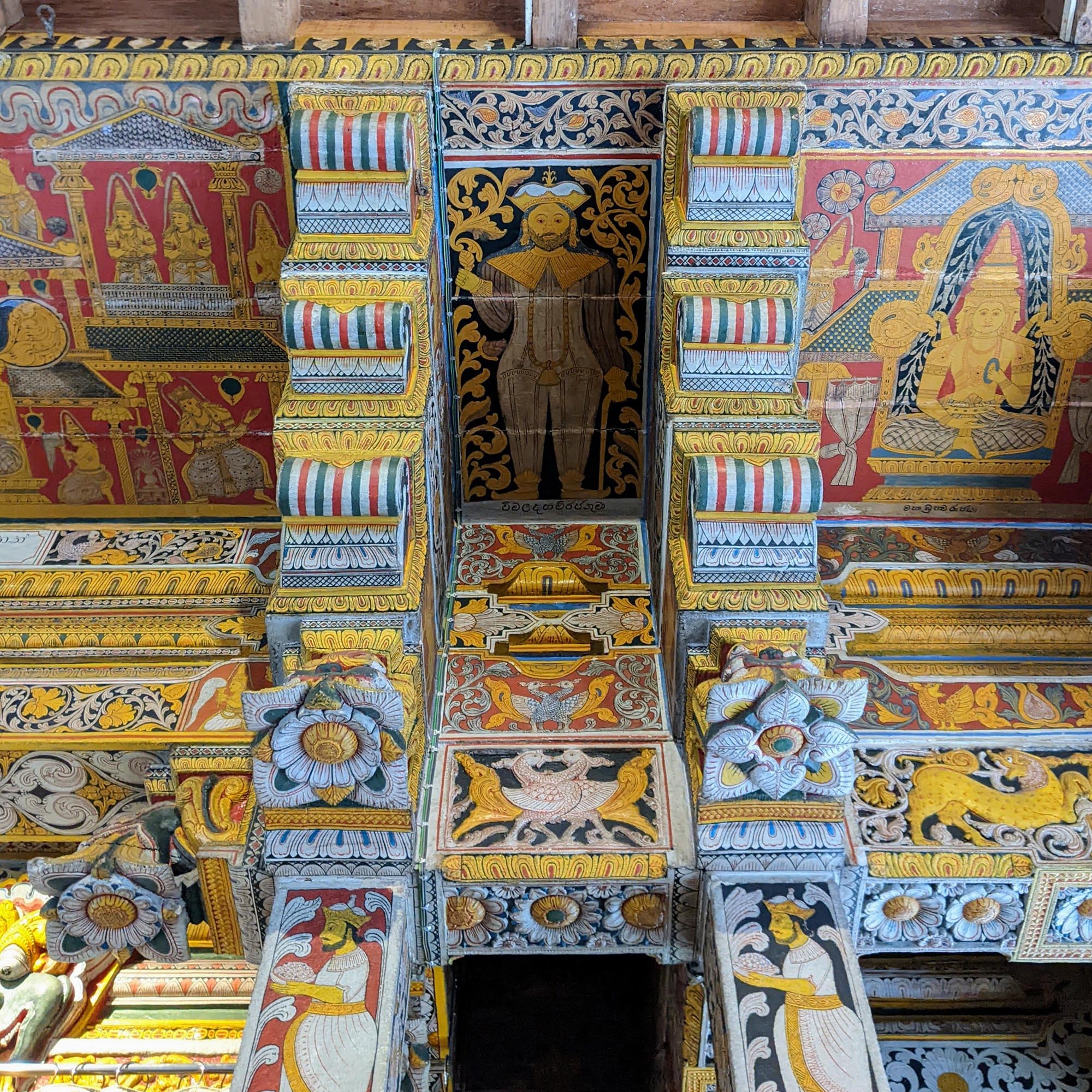
Ceiling and mural paintings in natural pigments on wood and plaster, Temple of the Sacred Tooth, Kandy — 18th century; likely restored in the late 1990s. | © Chinthaka Rathnayake - Suriyakantha CAC (Pvt) Ltd
Style and Storytelling
Kandyan murals are instantly recognisable: bold outlines, flat planes of red and yellow, stylised vegetation, and figures rendered without perspective or shading. Narrative took precedence over realism, with sequential panels depicting episodes from the Buddha’s life, his previous births (Jataka tales), and local legends. Decorative floral and animal motifs often fill ceilings and borders, blending storytelling with pure ornament.
The result is an art of powerful clarity — designed not for aesthetic indulgence alone, but to teach, inspire, and reinforce the faith of devotees. Even today, the walls of Degaldoruva, Ridi Vihare, and the Temple of the Tooth preserve these luminous testaments to an era when religion, kingship, and art were inseparably intertwined.
© 2025 Suriyakantha CAC (Pvt) Ltd | All Rights Reserved