
Lime Container (කිල්ලොටය)
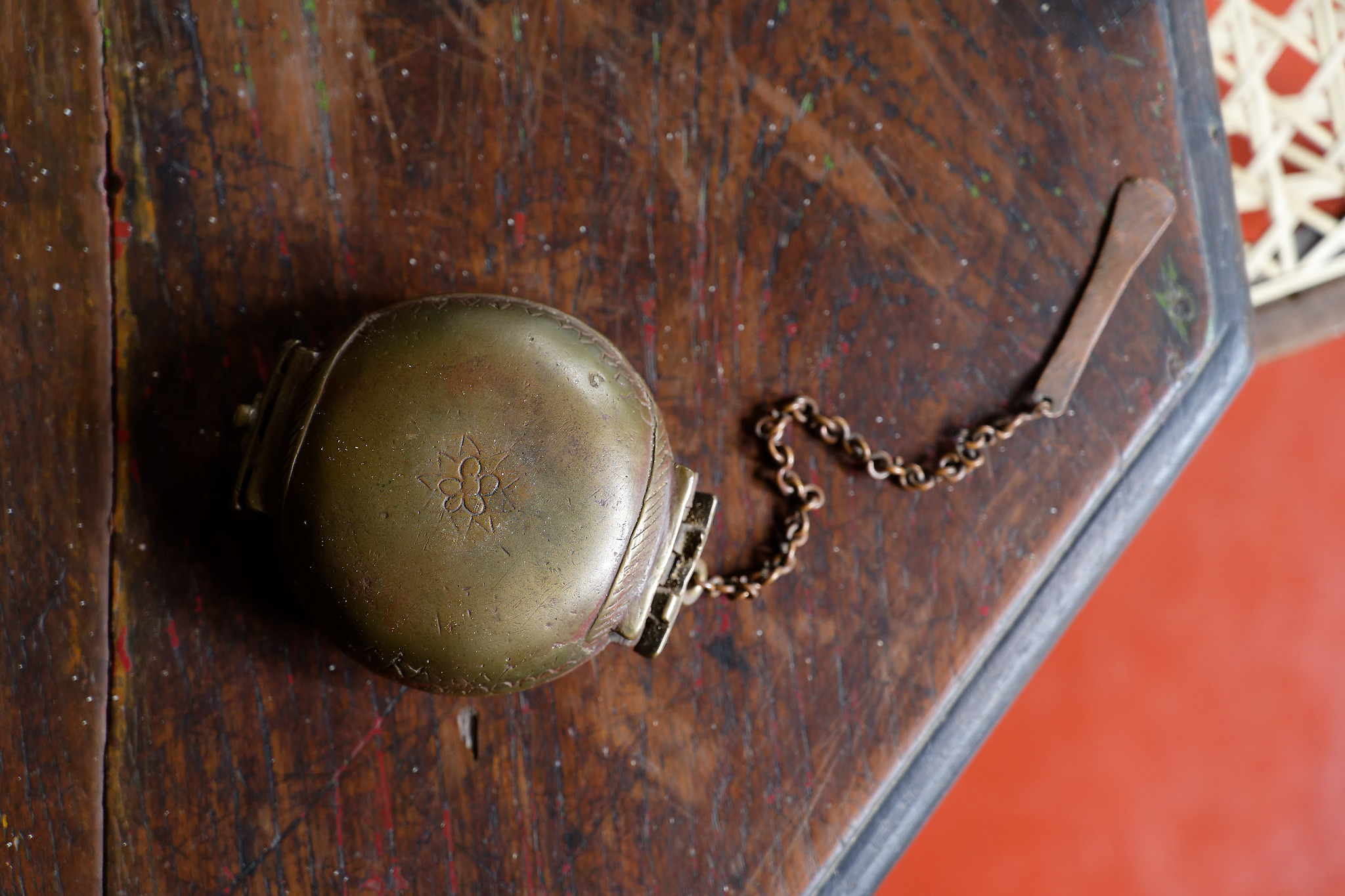
Small enough to slip into the fold of a sarong yet sturdy enough to travel between villages, the killotaya held slaked lime paste (chunam).
A dab of this alkaline powder, mixed with sliced areca nut and betel leaf, activates the mild stimulant cherished throughout South and Southeast Asia.
Sri Lankan artisans cast the box as a flattened sphere whose lid flips open on a tiny hinge. Inside, a spoon on a chain allows the betel chewer to scoop out just a trace of lime. Many examples—like this one—are finely chased with scrolling petals, while aristocratic versions were worked in silver or even gem-set gold. Most, however, were of humble brass or copper, their soft metal patinating to warm browns through years of handling.
The killotaya’s form recalls an 18th-century European pocket-watch case, suggesting a cross-cultural design exchange during the Dutch and early British periods. Yet the object remains unmistakably Sri Lankan: from the locally mined coral-lime within to the floral scrolls that echo Kandyan temple ceilings.
Crafted from brass that resists lime’s caustic bite—an example of material ingenuity—each killotaya is topped with a tight-fitting lid to keep humidity at bay. Yet these pocket-sized lime boxes could also broadcast personal prestige: silver or gem-inlaid versions were courtly luxuries, and a finely chased specimen with its spatula still intact, such as the one shown here, would likely have belonged to a provincial official or wealthy planter.
Today these diminutive containers speak to a layered history of trade, ceremony and daily life—where a single pinch of lime linked craftsmanship, landscape and convivial exchange.
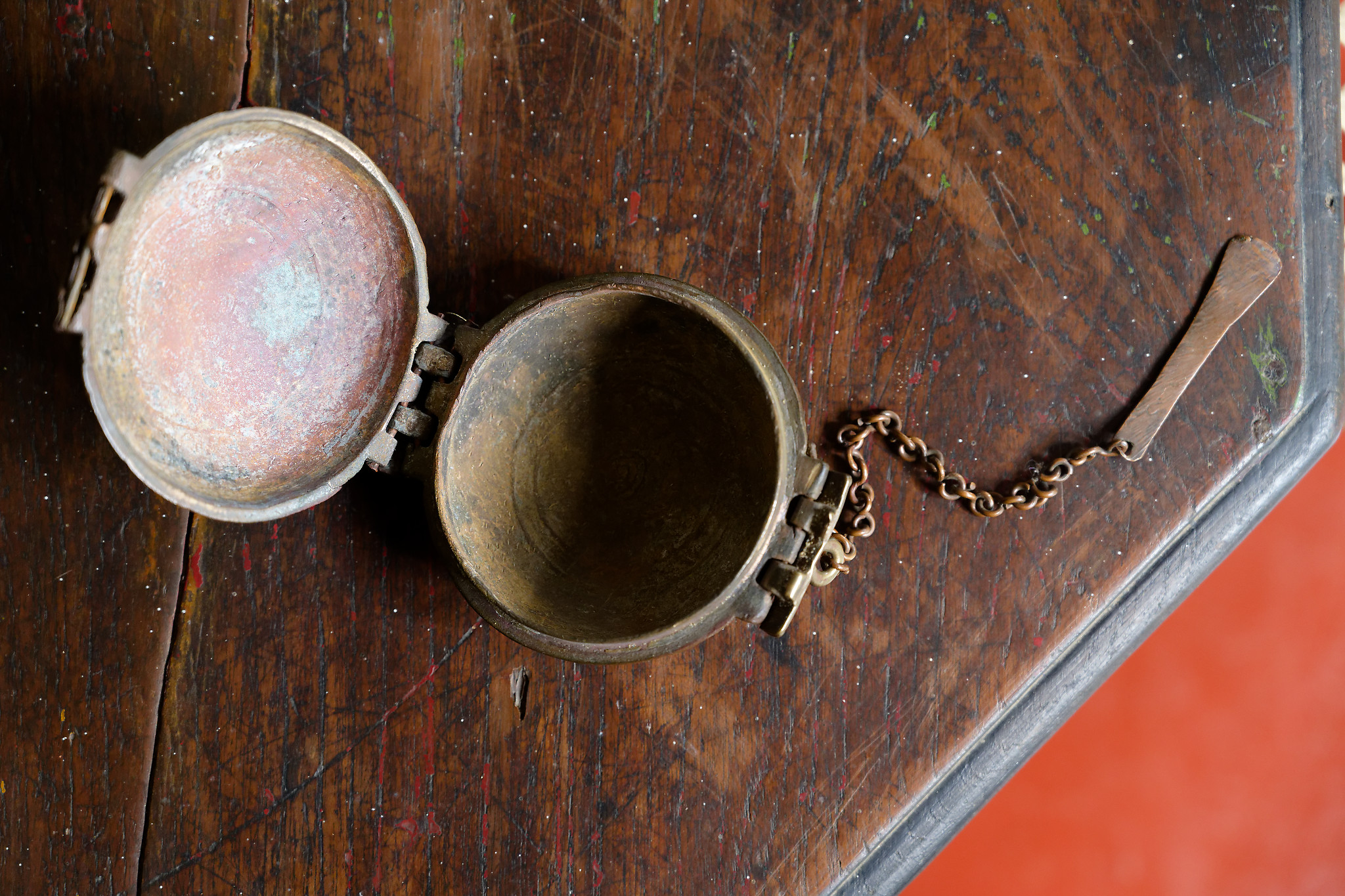
Kingdom of Kandy (central Sri Lanka), late 18th – early 19th century | Brass (or copper) with chased floral decoration, hinged lid, iron clasp and chain-mounted copper spatula © Janaka Samarakoon - Suriyakantha CAC Pvt Ltd.
A PERSONAL SUPPLY FOR SAFETY
In the betel-chewing tradition, the areca nut and betel leaf could be shared or borrowed without hesitation, but lime was a different matter. People often feared that lime borrowed from another household might be deliberately poisoned. For this reason, betel chewers carried their own supply in a killotaya, ensuring both convenience and personal safety. This custom made the lime container one of the most personal and indispensable items in daily life.
The lime stored inside (chunam) was made by burning coral or seashells, then slaking it with water—a process used for centuries across the Indian Ocean world.
The killotaya’s shape—flattened, lidded, and compact—closely resembles European pocket-watch cases, hinting at stylistic exchanges during Dutch/British periods.
© 2025 Suriyakantha CAC (Pvt) Ltd | All Rights Reserved