
SURIYAKANTHA INTRODUCES CREATIVE RESIDENCY
Let Suriyakantha become part of your creative journey.
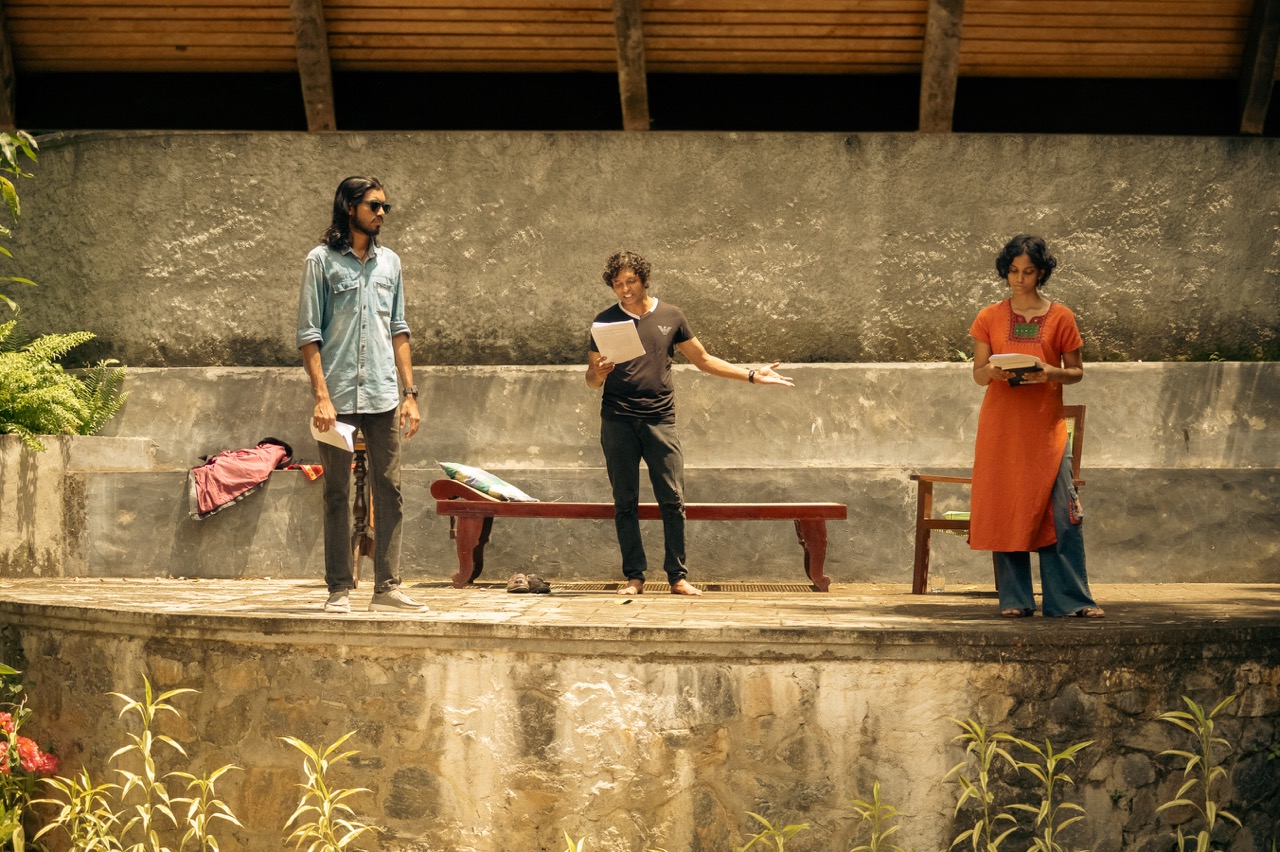
A programme open to artists, writers and creatives from all backgrounds, within a three-hundred-year-old heritage residence.
This summer, we are launching a new creative residency programme at Suriyakantha.
Open to artists, writers and creatives from all backgrounds, this programme allows one person engaged in a creative practice — literature, visual arts, research, photography, film, music or any other discipline — to stay for a minimum of one week in our three-hundred-year-old heritage residence, at a preferential rate.
During their stay, the resident — who may be accompanied by one guest — has a private space and access to the house's emblematic areas: the sitting room, the libraries, the verandahs, the galleries, the inner courtyard and the garden. These are all spaces where the calm, the beauty of the setting and the memory of Suriyakantha offer particularly fertile ground for creation.
Last May, we had the pleasure of hosting French regional historian and writer Guilhem Beugnon. At the request of Thema Collection, owner of Mountbatten Bungalow in Kandy, among other properties, the writer used his few weeks at Suriyakantha to carry out iconographic research into Lord Mountbatten's stay in Kandy.
Guilhem Beugnon also brought together, under our roof, a body of personal writing deeply marked by this place of such particular charm.
Here, as a preview, we offer an excerpt from a text written at Suriyakantha, steeped in the singular atmosphere of our three-hundred-year-old heritage residence.
— Rates and information: info@suriyakantha.org or WhatsApp (messages only) +94 71 362 3110
Tropical Liturgy
by Guilhem Begunon - May 2026
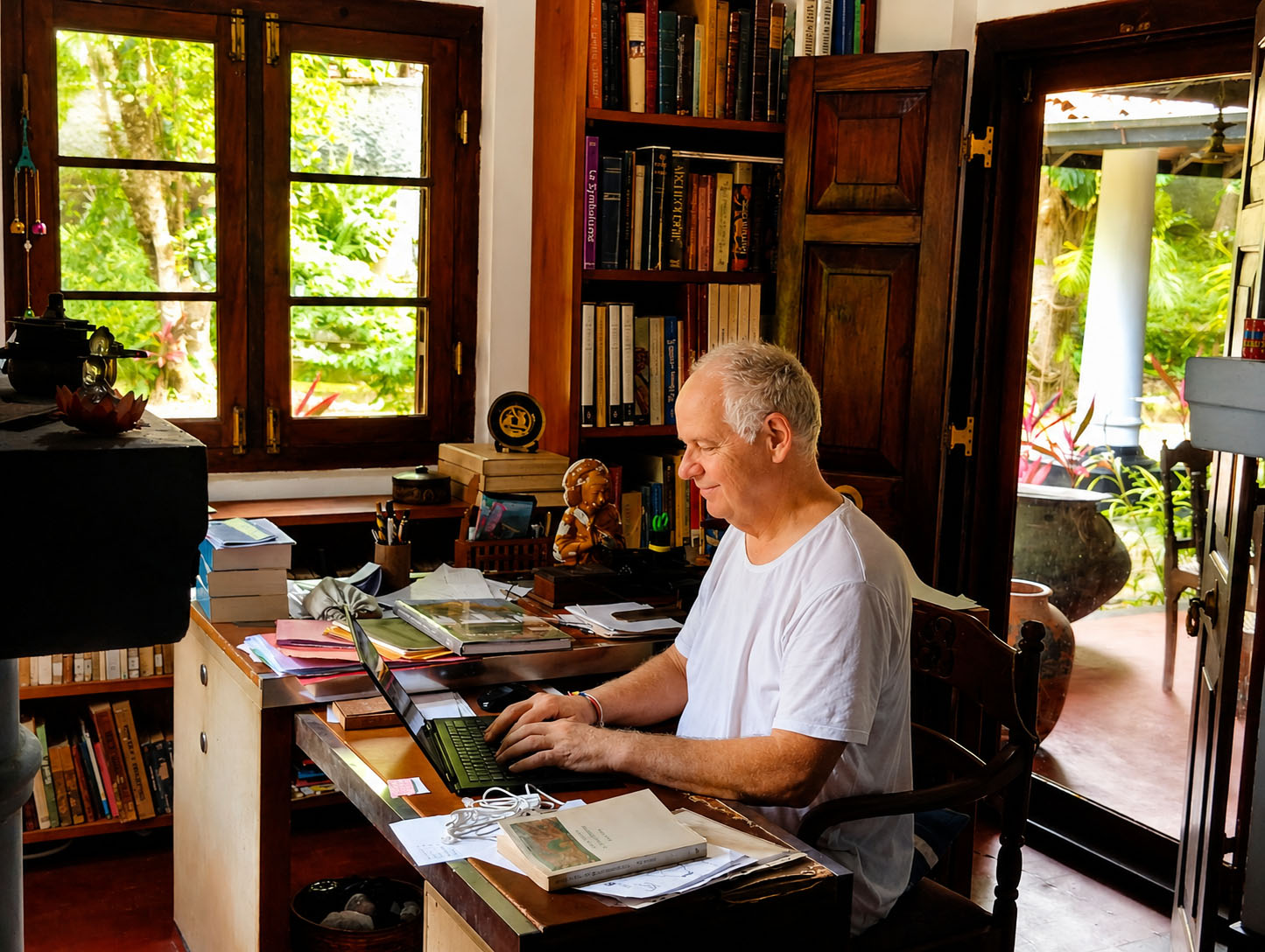
Guilhem Beugnon at Suriyakantha, Kandy, during his literary residency — May 2026 © Suriyakantha CAC (Pvt. Ltd)
—
Six o’clock in Daulagala, near Kandy, Sri Lanka’s cultural capital. At the Suriyakantha Centre for Art and Culture, the garden wakes to the melancholy, repetitive call of the Asian koel, the busy chatter of the common myna, the sudden uproar of parakeets crossing through the coconut palms. Small shrill cries, nervous and insistent—those of the palm squirrel, which I long mistook for birdsong—dart from tree to tree.
Quiet now, sounds of the night! Frogs and toads, insects and geckos, owls, the neighbourhood’s stray dogs, that ceaseless blend of chirring, rustled leaves and unseen cries. Make way for a new soundscape! Soon the CTB buses, then the woman next door’s sound system, which every morning fills the silence her children and husband leave behind when they head out. In the distance, I shall make out strains of Lambada and the French cancan.
My first acts will be to switch on the water heater at the mains and then the pressure pump connected to the tank on the upper terrace: two mechanisms far apart from each other, whose exact workings remain obscure to me. Yet only this combination seems capable of providing a hot, plentiful shower.
Then comes the hour of opening up—of opening everything—onto the luxuriant garden. Each window, each French window, has four or eight brass latches that must be unlocked every morning and locked again at nightfall. I proceed in a fixed order, so that none are overlooked and the chore becomes an almost Buddhist ritual.
Bedroom: three windows, one French window, twenty-eight clicks. West library: eight clicks, the matter is quickly settled. Entrance hall: twenty clicks, and the house opens onto the front verandah, where I am greeted in turn by the wagging welcome of Kaloo and Hadhaya, the household’s two dogs, and the smile of Bandula, the sprightly night watchman. He has just finished his own ritual of offerings and prayers before the ebony Buddha; a scent of incense and jasmine flowers hangs in the air. East library: four clicks only, the window is fixed. Offices: sixteen clicks, and already Hadhaya has curled up on the woollen rug, blissful. Dining room opening onto the inner courtyard: forty-eight clicks; the ritual gathers force. Exhibition room, rising power: sixty clicks. Kitchen and scullery: sixty-four clicks. The apotheosis of this tropical symphony of ironwork.
Far from exhausting me, this patient morning unlocking, repeated two hundred and forty-eight times, anchors me gently in the rhythm of the walauwa, without making me regret, even for an instant, the push-button ease of Europe.
Facing the ranks of switches, I now turn off, hesitantly, the lights of the night and turn on those of the day—more discreet, almost symbolic. The darkness retreats through the vast dwelling without ever wholly leaving it. After a night’s hunting, the resident toad returns to its favourite shelf: that of the venerable volume of Spolia Zeylanica. It seems to have taken up residence there. Our toad is a scholar.
Now I surrender gratefully to a hot shower, a spluttering luxury in the midst of the tropical damp.
Yesterday, the keeper of the temple of Lankatilaka was showing me, with evident pride, a rare fresco of a standing Ganesh, symbol of active protection and dynamic prosperity.
“Standing and potbellied,” I remarked to him.
“Like you,” he answered without hesitation, and rightly so. And so this morning, contrary to my habit, I did not drown my oat flakes under a generous layer of kithul treacle. Between asceticism and indulgence, one must find the Middle Way.
The day may now begin, under the sign of loving-kindness:
May it extend to the whole world,
above, below and all around,
without obstacle,
without hatred and without enmity.
But for the moment Dorothy is dozing in her great four-poster bed, cluttered with her kit for digital survival.
—
© 2026 Guilhem Begunon | © 2026 Janaka Samarakoon for the French translation