"Brown Paper"
2026 August 25


It is a book about the ordinary cruelties of the rural world, about what education costs and what it promises, and about a woman who kept her money "for later" all her life, only to discover that later keeps arriving, and always just in time.
BELGODA NILAME WAS A MAN APART. We have seen him arrive, tail between his legs, in a world at first hostile—a stranger forced to live in the overcrowded house of his in-laws. But very quickly this resourceful man took things back in hand.
He began by carving out a choice place for himself within the large family that had taken him in. Then he won over the village community, lending a hand with one man's fieldwork, advising another on a new planting method, helping a third to a better yield.
The man was a peasant, but a learned peasant. A scholar by nature. In the absence of a formal education, the school of life into which he had been thrown very early had taught him precious lessons: resourcefulness, a certain address, a sense of the collective, the instinct for survival. And a proven agricultural knowledge, born of intuitions and confirmed by practice, resolutely effective and, better still, transmissible.
Unlike many other men of the village—including, later, his own son-in-law—this illiterate man had grasped, as Leela's mother would in her own village, the importance of letters and of his children's education. Belgoda Nilame had little to offer his offspring: no land, no hidden fortune. Even his beautiful house stood on land belonging to his wife's family. There remained education: free, now, and within reach.
He also sensed the great social upheavals that were about to break, like a dyke giving way, over their little world—a world governed by an almost feudal order, arranged thus since time immemorial. Colonisation, after all, had scarcely penetrated the rural hinterland of Kurunegala. The colonial administration ruled from the capital, but this changed nothing in the peasants' two annual harvests, which went on setting the rhythm of their entire existence.
Belgoda Nilame himself could not read. He hardly ever went to town—two hours away on foot—and not often enough, at any rate, to fathom the obscure mechanisms and the new laws at work there. He was in no way equipped to face the world that was coming. But he prepared his children for it with astonishing foresight.
At a time when the village regarded the school that had just risen from the ground as a little whim of the new administration, destined to vanish as quickly as it had appeared, Belgoda Nilame saw in his children's education more than an opportunity: a sacred mission. He did not yet know what its reach would be, but he sensed its power, however confusedly.
⁂
It was he who rose early in the morning to get the children ready for school. Long before his young wife began her work in the second kitchen, the smaller of the two, the father was already ironing the little schoolchildren's uniforms by the faint glow of a kerosene lamp—in his hand a rudimentary iron, its belly alive with coconut embers.
By now the meal was ready. He would then leave the ironing table, dress the children in their clean, handsome, still-warm clothes, steeped in that comforting smell of steam, ironed linen and oily coconut meat burning on the embers, then seat the brood on the bench in front of the kitchen, on the rear veranda, facing the courtyard. The birds were already chirping; the sun had not yet appeared behind the paddy fields below. The grass still held its dew. Shivering in the morning cool, the children hugged their shoulders, half asleep, yawning as though they had just emerged from an all-night pirith chanting.
Holding the plate of rice in his left hand, a shallow earthenware bowl, the father, standing, shaped small balls with his right and brought them, one after another, to the children's mouths: five of them—or as many as eight, depending on the day, as the youngest of the other brood declared themselves present for the ritual. The little ones opened their mouths feebly in turn, like a nest of fledglings. The father gently placed a ball of rice inside.
With that, they were almost ready.
One final observance before the little ones ran off to school. The father would take hold of the bottle of oil always kept within reach—the very oil he prepared with his own hands from the coconuts of his land—pull the stopper with a little plop that made the drowsy children start, fill the hollow of his palm with a generous splash, then launch his attack on their jet-black heads. The children, who knew the manoeuvre, immediately planted their feet so as not to topple under the assault. The paternal hand went back and forth without ceremony, flattening locks, polishing skulls, taming rebellious cowlicks, and not forgetting to coat their forearms and calves—the oil was his miracle moisturiser too. A true little morning tussle, from which the children emerged defeated, but shining and impeccable, ready for school.
At the close of this domestic liturgy, it was he again who slipped a small coin into their pockets, so they could put something in their bellies at midday.
At that same hour, his son-in-law, who had children of much the same age, had already vanished from the household. Every morning, just as the whole house was coming to life, he would evaporate, off to take his breakfast at the local café—an urban habit little practised in the village.
Belgoda Nilame's eldest daughter therefore got her children ready alone. When it was time for them to leave for school, she would go into the bedroom—the parental suite adjoining the sitting room, the finest bedroom in the house—in search of a coin. She too would have liked to slip a few cents into her children's pockets, just in case. Some had evening sport practices and needed to buy a bun at the canteen; others had term fees to pay. But the husband had gone, locking behind him his precious mahogany cupboard where he kept his money. Helpless, the mother would beat the marquetry with her nervous fists. The cupboard, like its owner, remained silent. Not so the children's grandfather. Belgoda Nilame would then empty the little purse tied to his belt and cover the needs of this second family, his own grandchildren, whose father had money, and a cupboard to keep it in.
In the middle of the afternoon, if work in the fields did not hold him back, he would scan the horizon for the silhouettes of his little ones returning from school. Once the troop had been gathered in, he lavished care upon them, treating them like true soldiers home from the front. He pampered them, he washed them, he stuffed them with food. Poor little things, he thought. The world outside was a battlefield, and they needed strength to face it.
On rainy days the man grew nervous. He could not bear the thought of his children catching cold or coming home soaked. He would gather up all the umbrellas lying about the house, those of both families, then make himself another by cutting a frond from a young palmyra palm. Barefoot—as always, in all circumstances—he would set off, his palmyra frond spread above his head, along the path to the school: thirty minutes' walk in the rain, by that half-wild track that cut across the neighbours' plots and the coconut groves. At the school gate he would assemble his troops, the little ones of both families, a single regiment now, distribute the umbrellas, and repatriate the whole company safe and sound. And, above all, dry.
Every year, at the beginning of term, he himself took charge of covering the children's schoolbooks in brown paper, though he could not read a word of them. He never missed one of the parent meetings held at regular intervals at the school, whose convoluted formulas left him dumbfounded. Yet he never hesitated to speak—there, or at village gatherings—whether to say what he thought or to have a wrong put right. Illiterate, he made up for it with a quick mind and clear thought, carried by a natural authority.
Leela’s father-in-law was an anachronistic man. Not because he belonged to the past. On the contrary: he was a man of the future, fully modern. A man who had placed his vocation as a father before his prerogatives as a man. His wife—still of tender years, little exposed to life, worn down by successive pregnancies, always a toddler on her hip, and having never herself set foot in a school—remained a little withdrawn, a little overwhelmed by the machinery of life, which seemed to be gathering speed beyond the perimeter of the home. Her husband therefore occupied, as the elder of the couple—the age difference between the spouses being far from negligible—the place of the one who had seen more, whom life had more solidly hardened, and who, for that very reason, seemed the better equipped to stand up to it.
This man filled the father's place in the household to the full, and even part of the mother's. He certainly could not read his children's schoolbooks, which he sheathed with such devotion, but he knew how to read his time. From an almost feudal observation post, he anticipated a modernity whose advent he would probably not even live to see. He possessed almost nothing, but he gave his children the only wealth capable of making the crossing into the world that was coming.
© 2026 Janaka Samarakoon
Mother's Room - Translated from the French by the author
Éditions Suriyakantha - Forthcoming winter 2026-27
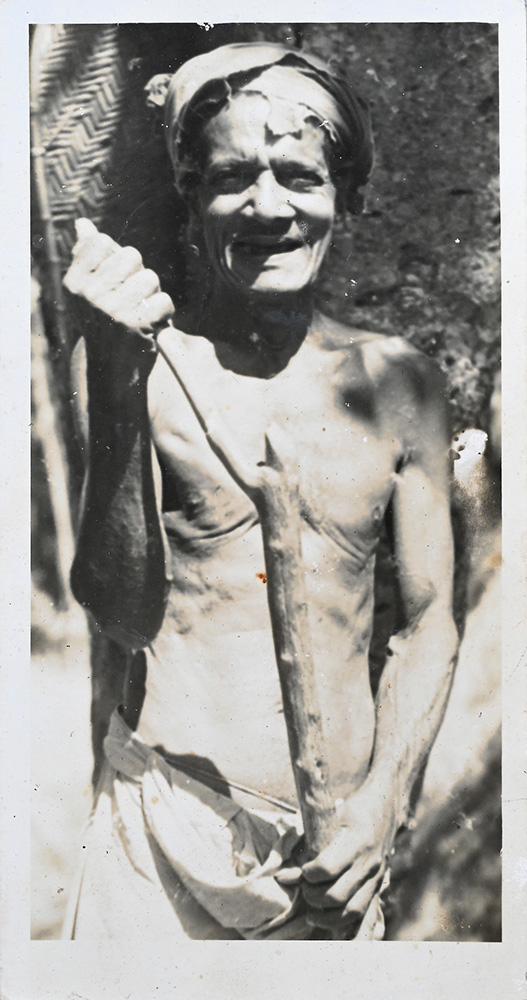
Belgoda Nilame in the late 1970s, standing in his field with the tool that rarely left his side. Photographer unknown. Author's private archive. All Right Reserved.
Share this article
A Nanda Malini Baby
2026 August 21