
Suriyakantha
Staying at Suriyakantha
…Time passes differently here, for the space is like no other.
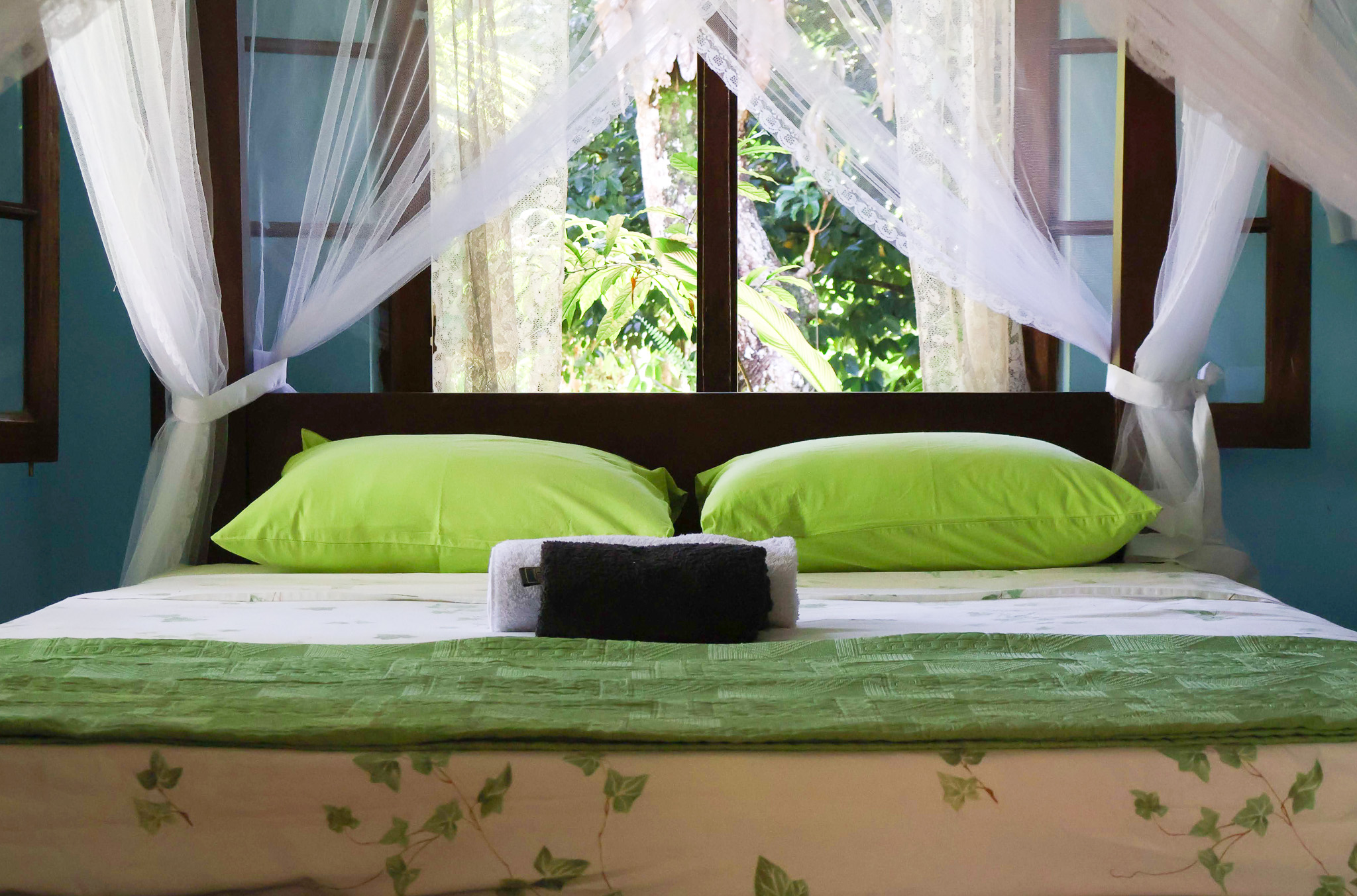
Suriyakantha is not a hotel. It is an ancestral Kandyan manor house, a walawwa, now a museum and cultural centre, where a single room remains open to those who wish to discover the Kandyan art of living from within.
Here you sleep among the old books, the paintings, the early sea charts and the ola-leaf manuscripts of the collection; you take breakfast on the veranda, facing the garden — a barely tamed fragment of Kandyan forest, home to the endemic birds and fruit trees that are the pride of this exceptional land.
Time passes differently here, for the space is like no other.
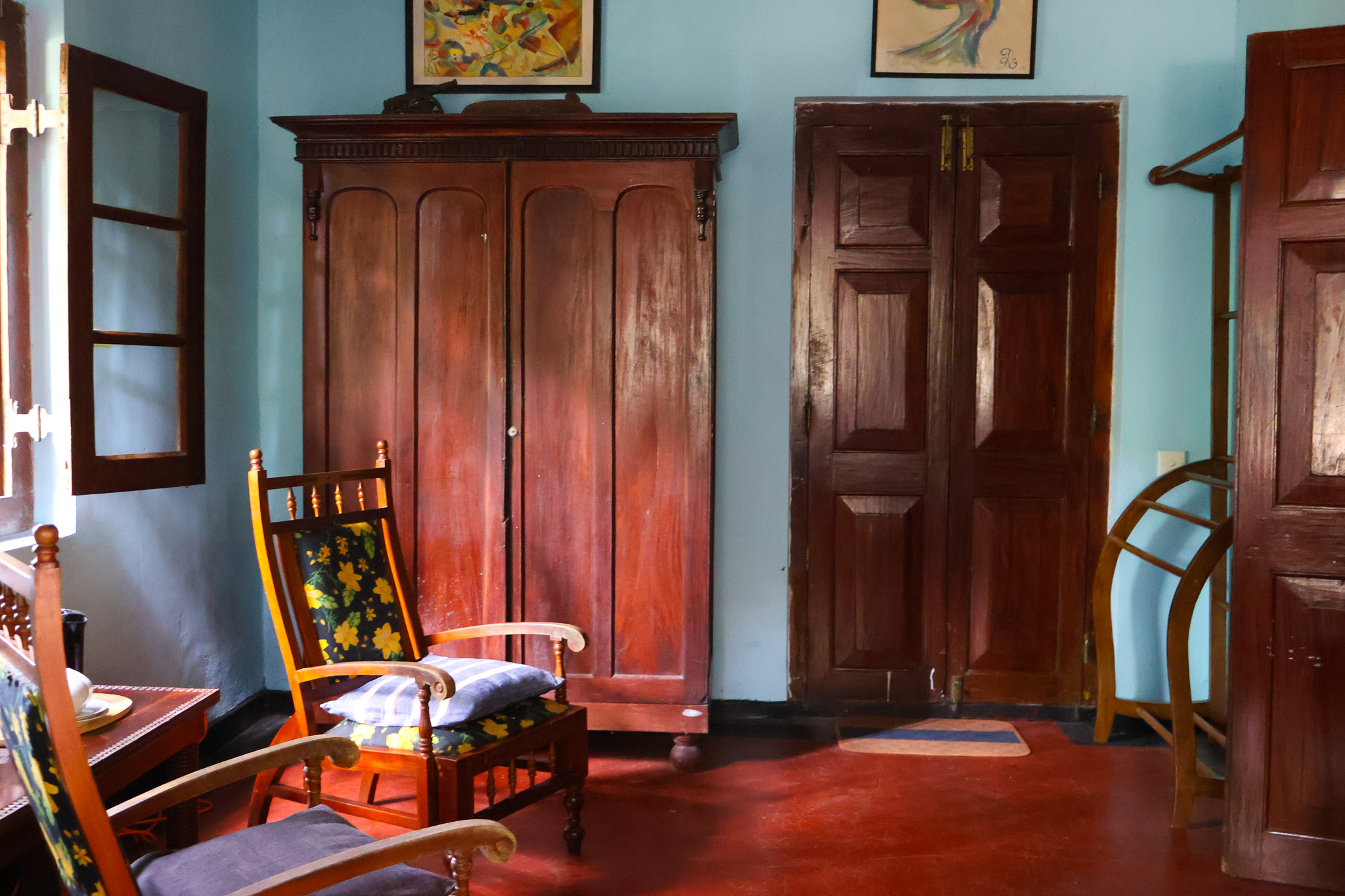
The sitting area of the guest quarters © 2026 Joséphine Bertin for Suriyakantha CAC Pvt Ltd
The house
The house opens onto a tropical garden, a terrace and an inner courtyard. The room, with direct access to the main veranda, looks out over the greenery. The quiet is that of the Kandyan countryside: birds at first light, the light falling between the whitewashed columns, rain on the tiles in the monsoon season.
Free private parking is available on site.
Book on Booking.com Book on Airbnb
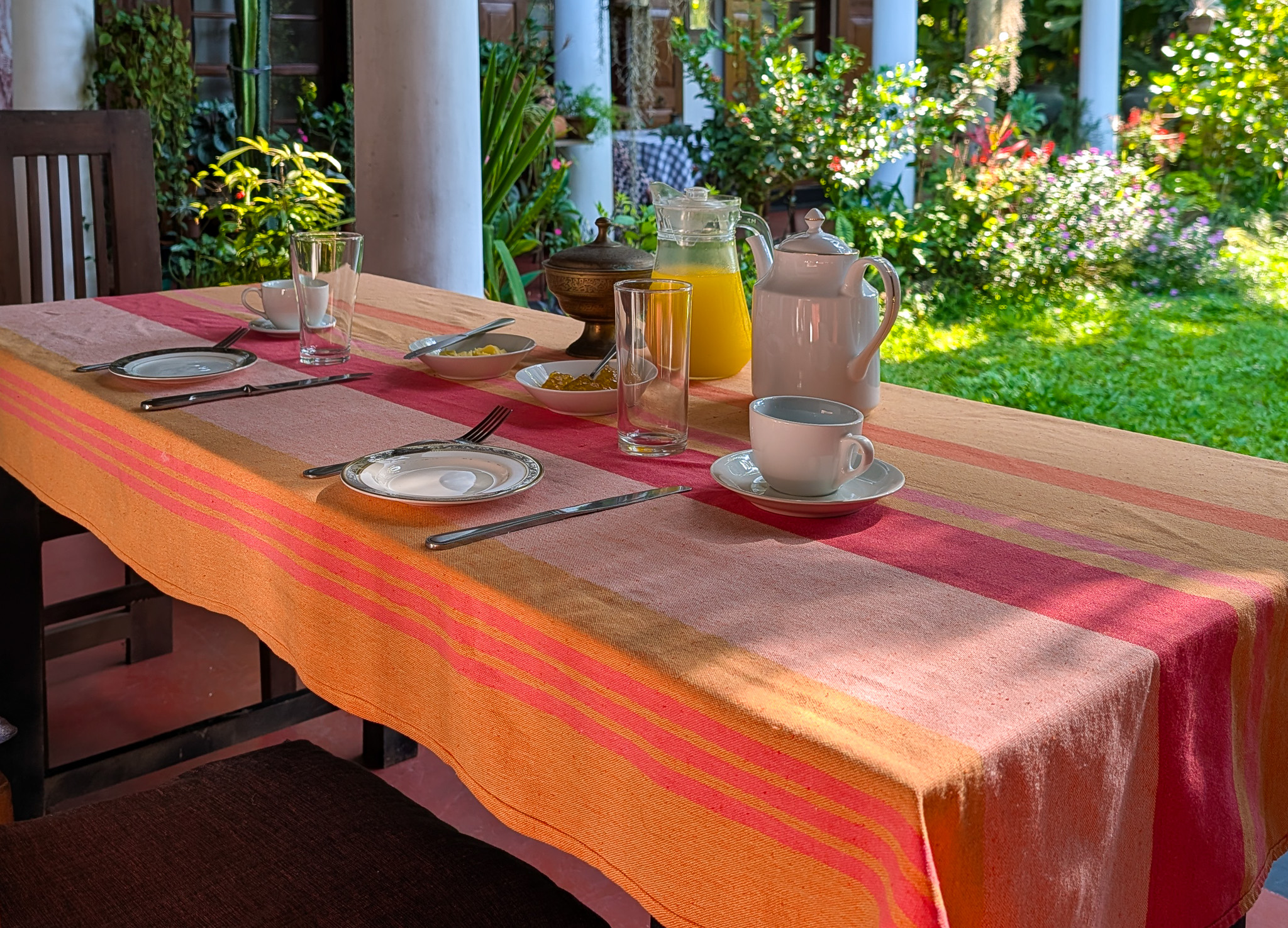
The dining area, set out around the inner courtyard © 2026 Joséphine Bertin for Suriyakantha CAC Pvt Ltd
Those who have stayed here put it better than we can…
The vast house wakes in darkness. I grope my way across the polished cement floor, brushing against the heavy Dutch furniture that fills the sitting rooms, its delicate ebony inlays still hidden in the gloom. Then begins the unchanging ritual of clicks and clasps. Latch after latch, the light comes in, slipping over yellowed photographs, Dutch dishes and talipot manuscripts, scattering tiny sparks across betel boxes and ceremonial lamps, slowly unfurling the sleeping tangle of cats. Kept overnight from the animals' covetous attentions, the cheerful cotton cushions, stacked in a dark corner of the sitting room, happily return to their cane armchairs and daybeds.
— Guilhem Beugnon, Tuk-Tuk Stories, Éditions Suriyakantha, 2026, 160 pp., LKR 3,000.
Nearby
The circuit of the three temples
A few minutes from the house lies one of the most remarkable ensembles of Sinhalese art: three fourteenth-century sanctuaries, contemporaries of one another, raised under the kingdom of Gampola and linked by a footpath across the paddy fields.
- Gadaladeniya — built in 1344 on a rock outcrop at Diggala, in the reign of Bhuvanekabahu IV, to the design of the South Indian architect Ganesvarachari. A temple of stone, where the art of Vijayanagara meets the Sinhalese tradition; frescoes survive in the shrines.
- Lankathilaka — of brick, set on a rock reached by a long flight of steps cut from the level of the paddy fields; one of the best-preserved buildings of the Gampola kingdom. Paintings of the Gampola period in the shrine room.
- Embekke — the wooden devalaya, founded under Vikramabahu III (1357–1374) and dedicated to Kataragama deviyo. Its drummers' hall, with thirty-two carved ironwood pillars, is held to be the summit of woodcarving on the island: entwined swans, wrestlers, dancers, double-headed eagles.
All three can be seen in half a day, on foot or by tuk-tuk, for those who want to take the landscape at its own pace.
Eladetta, Robert Knox's village
On the Daulagala road, barely two kilometres from Suriyakantha, lies the hamlet where the English sailor Robert Knox, held captive in the Kandyan kingdom for close to twenty years, bought land, built his house and planted his orchard. The deed of sale was set down on ola leaves. It was from Eladetta that he made his escape in 1679; out of his exile came An Historical Relation of the Island Ceylon (1681), the first substantial European account of Kandyan life — and one of the sources of Robinson Crusoe. A memorial stone laid in 1908 still marks the site of his house.
Even before I caught sight of the diploma, the books had given the game away: the house, beyond any doubt, belonged to a psychiatrist. On the rosewood shelves, Jung's The Soul and the Self sat beside Ellenberger's The Discovery of the Unconscious and Freud's Introductory Lectures on Psychoanalysis. Jacques Soulié left this world in July 2025, but, polymorphously curious as he was, his spirit still wanders among the shelves, where hundreds of art books, poetry collections and austere volumes of religious anthropology jostle for space. The titles crowd together, whirl, intimidate and intoxicate me. Dorothy, for her part, scans the shelves with a more pragmatic eye. "You certainly don't have a cookbook?" she asks Prasanna, Suriyakantha's on-site manager, who is trailing along behind us, after pushing Jung, Freud and Ellenberger aside like old uncles grown a little too talkative.
— Guilhem Beugnon, Tuk-Tuk Stories, Éditions Suriyakantha, 2026, 160 pp., LKR 3,000.
Also within reach
- Royal Botanic Gardens, Peradeniya — 5.9 km
- Penideniya railway station — 4 km
- Kandy railway station — 11 km
- Kandy City Centre and Bogambara Stadium — 12 km
- Victoria Reservoir seaplane base — 33 km
- Pinnawala Elephant Orphanage — 34 km