
Marie Gatellier, "Mural paintings from Sri Lanka. Kandyan school 18th-19th centuries"
2023 June 23
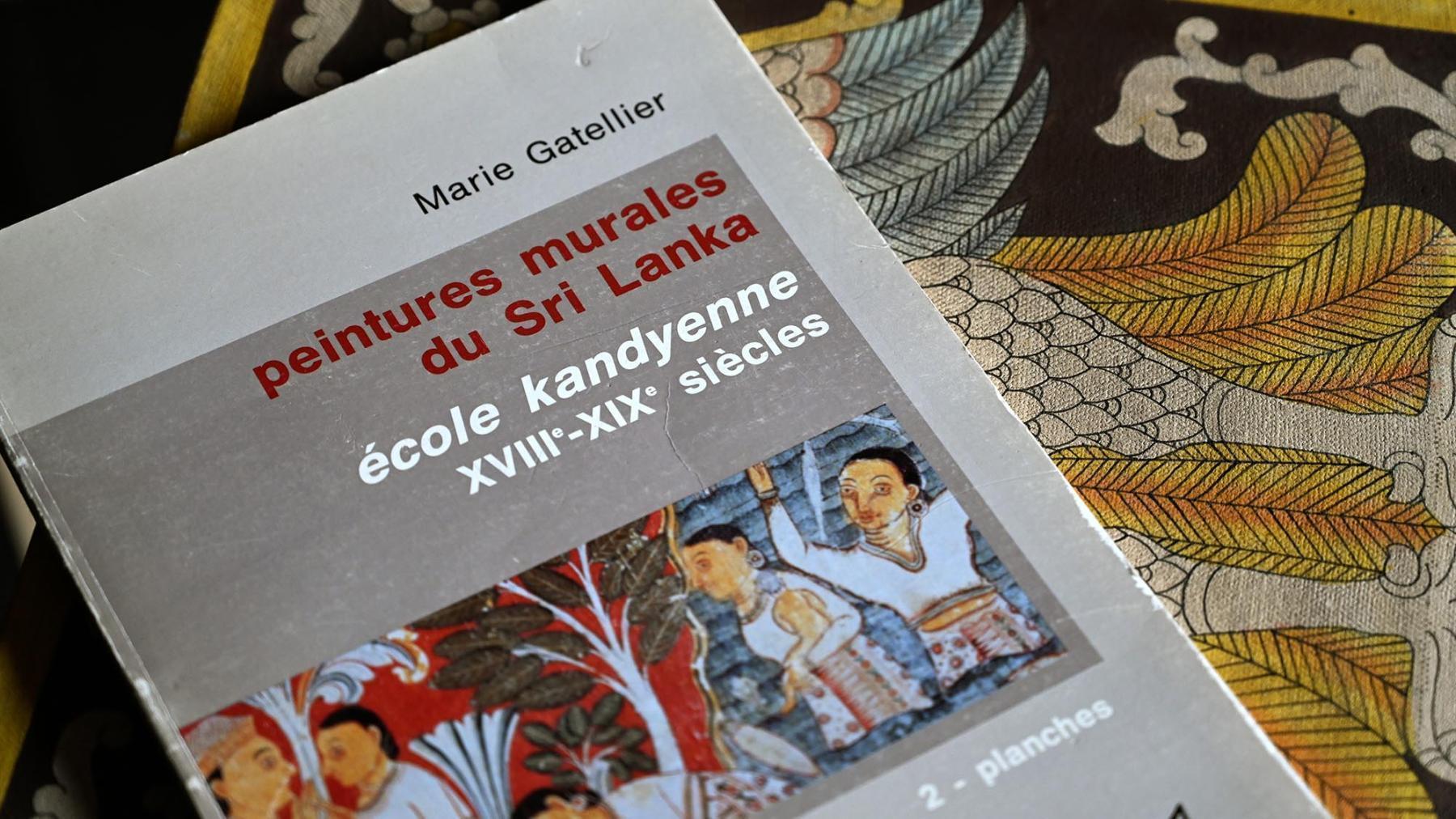
Vol. 1: Text, 266 pp.; Vol. 2: Plates, 152 pp., 27.5 x 18.5 cm.
Publications of the École française d’Extrême-Orient, Vol. 162, Paris, 1991.
Marie Gatellier’s Peintures murales du Sri Lanka. École kandyenne XVIIIe–XIXe siècles, published in 1991 by the École française d’Extrême-Orient, remains to this day the most comprehensive French-language publication devoted to the emblematic pictorial tradition of Kandyan mural painting in Sri Lanka.
This two-volume work is the result of an extensive research project that Gatellier—an expert in Asian art—undertook from the early 1970s onward, travelling widely across the island to gather documentation. The volumes feature several hundred illustrations, each accompanied by detailed captions, making the work an invaluable documentary resource.
Upon its release, the book received a critical review by Dr. Jinadasa Liyanaratne, lecturer at the Institut national des langues et civilisations orientales, a specialist in Asian art and Buddhism, and a contributor to the journal Culture. His review was published in 1993 in Arts asiatiques, Volume 48.
The document reproduced here, released under a Creative Commons license, is sourced from the Persée platform—an academic digital repository supported by the ENS de Lyon and the CNRS, and funded by the French Ministry of Higher Education, Research and Innovation.
In this work, Marie Gatellier (M.G.) examines a significant component of Sri Lanka’s cultural heritage: mural paintings that constitute a living art form—one that resonates not only with the aesthetic but also with the spiritual sensibilities of Sinhala Buddhists. As M.G. writes at the end of her study: “By combining imagination and grace with respect for tradition, they fully achieve their original purpose—didactic in nature—of bringing the Buddha’s Teaching to life before the eyes of the faithful” (p. 244).
This statement equally reflects the author’s own stance toward her subject—a posture that may be described, in Sanskrit poetics, as sahrdaya, or one marked by heartfelt sensitivity. Aesthetic appreciation underpins the entire study. As M.G. explains, her objective was “to identify and analyse, as far as possible, the main themes depicted in these murals and to highlight the guiding and shared principles of their iconography” (p. 5).
To achieve this, she spent many years in Sri Lanka. Following initial visits in 1970 and 1973, three extended field missions—in 1978, 1980, and 1984—allowed her “to travel extensively through Sinhala territory, to systematically visit even the smallest shrines, and to compile documentation comprising over 3,000 photographs” (p. 5).
M.G. carried out her work with great thoroughness. Even paintings located in remote or dimly lit areas did not escape her attention. For instance, in her discussion of the Maharajalena murals at Dambulla, she notes that “the execution is remarkably fine and meticulous despite the height and position of the surface” (p. 81); and regarding the scene of Vijaya’s arrival in Lanka, she writes: “In 1984, dark streaks partially covered these paintings, and given the dimness of the location itself, they could not be studied without portable lighting” (p. 201).
Her analytical approach is consistently sharp and observant. This is evident throughout the book—for example, in her discussion of tree representations in the murals (pp. 47–48).
M.G. rightly relies on textual sources—primarily the Jataka tales and other Buddhist narratives—for the identification and iconographic analysis of the murals. However, it seems that she did not always fully exploit the breadth of available primary and secondary sources pertinent to the Kandyan period. For instance, when delineating the geographical extent of Kandyan mural production, she merely states that over time, the borders of the Uda-rata shifted, though the five regions of Singuruvana [sic], Balavita, Matala [sic], Dumbara, and the three Sagama remained the kingdom’s core (p. 17). In fact, as detailed in the article on Uda-rata in the Sinhala Encyclopaedia, by the early 19th century, the Kandyan kingdom comprised twelve provinces (disa) and nine regions (rata), including Satara Korale, Sat Korale, Uva, Matale, Sabaragamuwa, Tun Korale, Walapane, Uda Palata, Nuwarakalaviya, Wellassa, Bintenne, Tamankaduwa, Udunuwara, Yatinuwara, Tumpane, Harispattuwa, Dumbara, Hevahata, Kotmale, Uda Bulatgama, and Pata Bulatgama. Moreover, large portions of the coastal areas remained under Kandyan control, particularly under King Rajasinha II (1629–1687), until Kirti Sri Rajasinha ceded them to the Dutch in 1766. These historical and geographical factors explain the presence of so-called “Kandyan school” murals in certain coastal areas—murals that M.G. divides into two stylistic categories: the “first” encompassing 18th-century Kandyan temple paintings, and the “second” referring to those found in western coastal shrines of the 20th century (p. 34).
Regarding technical treatises essential to the study of Kandyan art, one notes the absence of any reference to Hans Ruelius’s important dissertation, Sariputra und Alekhyalakṣaṇa (Göttingen, 1974).
In the historical and religious overview (pp. 11–29), M.G. rightly highlights Sri Lanka’s relations with Burma and Thailand during the period under study, citing the mural traditions of those countries for comparative purposes (pp. 243–244). Sri Lankan scholar Siri Gunasinghe, among others, has long pointed out the similarities between Kandyan and Thai mural painting. However, with respect to the two missions sent by King Vimaladharmasuriya II to Arakan to restore the upasampadā ordination lineage in Sri Lanka, M.G. references a 1941 communication by D.B. Jayatilaka, overlooking a more recent article offering new insights—P.E.E. Fernando’s “The Rakkhanga-Sannas-Curnikava and the Date of the Arrival of Arakanese Monks in Ceylon” (University of Ceylon Review, vol. 17, nos. 1–2, Jan–Apr 1959, pp. 41–46). Likewise, she omits mention of a valuable historical document on the subject housed in Paris (see J. Liyanaratne, “Notice sur une lettre royale singhalaise du XVIIIe siècle conservée au Musée de l’Homme à Paris,” BEFEO, Vol. 73, 1984, pp. 273–283).
Furthermore, on the theme—ubiquitous in Theravāda art—of the 24 or 28 past Buddhas, M.G. neglects the Jinabodhāvali, a poem composed during the period and authored by the writer of the Saddharmālaṅkāraya, whom she herself cites at length (pp. 186, 196). In the critical edition of the Jinabodhāvali (BEFEO, Vol. 72, 1983, pp. 49–80), I noted the Mahāyāna roots of the concept of past Buddhas and its resonance within Sinhalese kingship.
M.G.’s claim that interest among the Sinhala elite in Kandyan painting is a “very recent” phenomenon (p. 5) is not entirely accurate. L.T.P. Manjusri alone wrote extensively on the subject beginning in the early 1950s. His selective bibliography lists 155 Sinhala-language publications and 55 in English (Design Elements from Sri Lankan Temple Paintings, Colombo, 1977, pp. 226–230). Manjusri deserves special mention, as he dedicated much of his life—from the late 1930s onward—to documenting temple murals across the country. As both a painter and a former Buddhist monk, he was uniquely equipped—linguistically, philosophically, and culturally—to undertake such work.
By contrast, M.G. appears to have encountered certain linguistic limitations, which resulted in a number of errors. A few examples: Andabhūta Jātaka (p. 72 and passim) instead of Andhabhūta Jātaka (anda = egg; andha = blind); Silvatenna (p. 56), a misreading originally made by Ananda K. Coomaraswamy, instead of Silvat tana (a term for the disciples of Välivita Saranankara sāmaṇera); magin saka (p. 114) instead of Mahin[sa]saka (Mahimsasa); enuvara gahesi (p. 117) instead of lunuvarana gasehi (cf. photo 25); Ambugala (p. 16) instead of Ambulugala; Karaliyadde (p. 19) instead of Karalliyadde; and finally, “Sri, goddess of fortune and posterity” (p. 242), where “prosperity” would have been more accurate.
Despite these minor flaws, they do not detract from the essential value of the work, which remains the most thorough study of Kandyan mural painting published to date.
— Jinadasa Liyanaratne
Share this article
Comunicato: Suriyakantha lancia la sua prima audioguida a Kandy
2025 September 25